Sunday, July 25, 2021

Critical Race Theory as a theoretical framework for solving social problems


The nation’s attention has been drawn front and center to the use of Critical Race Theory in the classroom. Stories of schools portraying all white people and American institutions as racist, make the headline news on daily basis. The latest, from Pennsylvania State University, involves a professor telling a student he’s oppressing someone because he stepped out of his house and took a breath. As radical as this sounds, it is the consequence of allowing liberalism to go unchecked on campus in the name of egalitarianism. While Americans are fighting back against the use of CRT, leftist professors are finding new ways to incorporate it in education. Critical Race Theory is not a lesson given to first graders to tell them white people are racist. It is a theoretical framework and analysis tool from which liberal scholars search for, and allegedly expose, the everyday racism of American society from education to health care.

The Daily Signal ran an article stating that the Biden administration backed off its support for an education group promoting the use of CRT. This may seem like a victory for many Americans, as the racially divisive educational tool is being portrayed as something new. CRT in education goes back to at least 1995 when, according to the book Critical Race Theory in Mathematics Education, William F. Tate introduced it to the educational community as a theoretical framework for identifying the “racist underpinnings of standardized testing” (Davis & Jett, 2019, p. 7). Tate, author of Toward a Critical Race Theory in Education (1995), which is considered a key piece of work influencing CRT scholars, was instrumental in shaping the way CRT is used in modern education. Currently serving as President of Louisiana State University, Tate eloquently states that Critical Race Theory is not something for the undergraduate student, but “a framework used in law school and PhD’s education to better understand how laws are formulated and the influence on law in everyday life.” That is a bold statement highlighting exactly why it is a waste of time to focus on CRT in elementary education.

One of Tate’s essays, School Mathematics and African American Students: Thinking Seriously about Opportunity-to-Learn, also written in 1995, illustrates how he incorporated Critical Race theorizing into mathematics education. Tate, looking at math through a CRT lens, believes math education is meant to maintain the status of social elites, and that African Americans have not been afforded the opportunity to learn higher mathematics, as it has been something used to keep them in a lower economic class. By using a CRT lens, Tate made the claim that math education has been cleverly used to hide discriminatory practices in fields such as health care (p. 432), for example, because they have not been taught the larger social roles mathematics play in developing models used in health care practices. He states that “those who have created such models have hidden their biased assumptions” and that it takes experts to expose this bias. Tate is also citing the role CRT plays in cognitively guided instruction. This view suggests that the thinking and everyday experiences of the students help shape the way they learn and understand math. Tate cited an article called On the Education of Black Children in Mathematics where the authors claim that black students are often dismissed when discussing their personal experiences as they relate to math problems. This is because math has traditionally been something that does not involve social situations. By failing to do so, however, CRT scholars believe math education fails to prepare African American students for life in the United States. One of the examples presented highlights the ridiculousness of such an assertion. Students were given a math problem tasking them to figure out the better deal on a bus pass. A ride to and from work was one dollar and fifty cents each way, while a weekly pass was $16.00. For a five-day workweek, the daily pass was the better deal. Incorporating CRT, however, means that the assessment was set up from a white supremacist perspective because the five-day workweek is a white construct (Tate, 1995, p. 439). This is an example of how they incorporate CRT in education, and they have been doing this since at least, 1995.

If CRT as an educational tool is to be stopped, the focus must be on the academic work being done in the universities. For instance, the book Understanding Critical Race Research and Methodologies: Lessons from the Field is a series of essays from left-wing scholars explaining how they have used CRT as a lens from which to view social problems and how to incorporate them in education. One such essay is entitled Understanding the Why of Whiteness (p. 13). The author, James Donner, acknowledges an important fact concerning CRT scholarship. Much of it is based on what they refer to as counter-narrative, or, counter-story-telling, as a means of verifying racism in the United States. This is something also mentioned in the book Critical Race Theory in Education: All God’s Children Got a song (2006, p. 3). Counter-storytelling relies on the stories told by people who have experienced racism. The problem, as Donnor (2018, p. 14) acknowledges, is there has been a lack of legal reference concerning these stories. In other words, a great deal of CRT scholarship is based on the idea that there is perceived discrimination, as it relies on the stories told by people who believe they are experiencing racism in America. The mission of CRT scholarship is to try to bring legal and historical precedence to the forefront of these stories in higher education. As Tate stated, it is not something for the undergraduate student. In another essay by Jerome Morris and Benjamin Parker entitled CRT in Education (p. 24), it is noted that any attempts to understand racial inequality through a CRT lens depends on considering the history of discrimination and how it affects racism today. “These considerations,” write Morris and Parker (2018, p.24) “are important because they provide varied perspectives to be distilled, interpreted, represented, and applied. The reconstructed product termed “history” is not the Truth, but rather the conclusions drawn from the resources employed, and the researcher’s interpretation of those resources.” Again, we have CRT scholars detailing the importance of oral histories and storytelling as the written record depicts the historical truths from the perspective of the oppressors.

If America is going to fix the growing problem of CRT in education, it is going to take more than demanding your children’s school refrain from its use. Critical Race Theory is a perspective being shaped and developed in our higher institutions of learning as a tool of analyzing social problems and implanting a permanent racial consciousness in the minds of young students. While many Americans find humor in the ridiculousness of college professors telling white students they are oppressing someone because they are breathing --- the disturbing reality is that attitude comes from serious scholars who have chosen to look at everything from a racialized perspective to prove America is racist. Critical Race Theory is a theoretical framework accepted by mainstream academia as a legitimate theory from which to engage in serious academic discourse. The work being done by these so-called scholars is the work disseminated down the chain, dictating the approach taken in elementary education. Stopping Critical Race Theory will require someone challenging the assertions on an academic level, within the institutions.

See my other articles on Critical Race Theory

Critical race theory is the social construct – In Defense of Our Nation

A deeper dive into the origins of Critical Race Theory – In Defense of Our Nation

Critical Race Theory as a means of coercive thought reform – In Defense of Our Nation

Critical theory as a psychoanalytical approach to the social pathology of racism – In Defense of Our Nation

Understanding the Deeper Methodologies Driving White Privilege Education. – In Defense of Our Nation

Methodologies of Critical Race Theory Part Two: Racist Mathematics – In Defense of Our Nation

Davis, J. & Jett, C. C. Inserting mathematics into Critical Race Theory in Education. From Critical Race Theory in mathematics education. (2019) New York, Routledge.

Donnor, J. K. Understanding the Why of Whiteness: Negrophobia, segregation, and the legacy of white resistance to black education in Mississippi. From Understanding Critical Race research and methodologies (2018) New York, Routledge.

Monroe-Hamilton, T. (2021, July 24) Professor to white male student: ‘You’re breathing, you may have oppressed somebody.’ Bizpac review.com

Morris, E. J. & Parker, D. B. CRT in Education. From Understanding Critical Race research and methodologies (2018) New York, Routledge.

Stiff, V. L. & Harvey, B. W. (1988) On the education of black children in mathematics. Journal of black studies, 19(2) pp. 190-203

Tate, F. W. Toward a Critical Race Theory in Education. From Critical Race Theory in Education: All God’s children got a song. (2006) New York, Routledge.

Tate, F. W. (1995) School Mathematics and African American students: Thinking seriously about opportunity-to-learn standards. Educational administration quarterly, 31(3) pp. 424-448

Tietz, K. (2021, July 23) Education department backs off promotion of group espousing Critical Race Theory. The Daily Signal.

Be sure to check out my latest book

Without a Shot Indeed: Inducing Compliance to Tyranny Through Conditioning and Persuasion


Sunday, July 18, 2021

Critical race theory is the social construct


The stage is being set for an epic battle over the role of Critical Race Theory in education as more states continue to ban its use, and teachers vow to continue teaching it. To what extent do teachers even understand what they are teaching? Critical Race Theory, when thoroughly examined, presents itself as an ideology that justifies systems of racial preferences, as concepts like achievement and success are seen as white social constructs. Solving educational problems like achievement gaps in math, are seen as attempts to hold minority students to standards built up to perpetuate white supremacy. Even the English language is now viewed as a tool that reinforces a racialized society by forcing non-English speakers into behavior patterns not conducive to their identity. How did language get pulled into CRT discourse in education and what is the end goal of stating the English language is racist? To examine this question, I will be reviewing an article entitled Introducing Langcrit: Critical language and race theory by Allison Crump, published in the journal, Critical inquiry in language studies.

While CRT scholars justify their opinions and their own racial biases by referring to everything in America as a white social construct, Critical Race Theory is little more than that itself. For example, Crump (2014) acknowledges that there is no current research model which evaluates how racism affects language use and that a Critical Race movement in English teaching has not taken hold. In response to this, she proposed an alternative approach called Critical language and race theory, or Langcrit for short. She is literally suggesting that language scholars incorporate the concepts of CRT and look for ways that race and racism interconnect “with issues of language, belonging, and identity” (Crump, 2014, pp. 207-208). If this does not fall in the framework of social construct, I do not know what does. Another example is from the book Critical Race Theory in Education: All God’s Children got a Song. On page 3 the authors admit that much of the academic discourse which has influenced Critical Race Theory over the past two decades has been influenced by what they refer to as, counter-stories to the mainstream narrative. Counter-stories refer to tales shared by individuals who believe they have experienced racism. While there is little doubt racism was a part of mainstream society at one point, relying on these stories to inform an academic theory that now dominates the educational discourse, is misguided. As I have stated before, they are looking for racism where none exists. Finally, CRT itself was founded on the idea that America’s civil rights movement had failed in delivering justice to racial discrimination in America. Derrick Bell, one of the theory’s key proponents, rejected the ideals of equality under the law and individual rights because they promoted a color-blind society (Crump, 2014). The only way to correct the course was to develop a system that viewed racism as more than an individual act, but something that reflects discrimination as being deeply ingrained in American institutions (Omi & Winant, 1994).

How does racism interconnect with language, belonging, and identity? According to Crump (2014, p. 208) an individual’s sense of self is swept away in national identity politics in a system that forces conformity through language use. In other words, white people force non-English speakers into identities not representative of their culture because they use language as a hierarchal system. Scholars examining language through the Critical Theory lens have rejected language as a system of linguistics, and view it as a system that creates social boundaries, exercises power in a way that controls what other people can or can not do and, a tool that shapes identity (Crump, 2014). On page 216, Crump (2014) justifies the use of CRT in language studies by citing the work of other CRT scholars (Sarkar, M., Low, B., & Winer, L. (2007). Pour connecter avec les peeps). They argue that minorities feel social pressure to conform to “standards of whiteness” when operating outside of their own social spheres. They refer to these social spaces as the inner and outer spheres. The inner sphere is where non-English speakers are home and among other non-English speakers of their own cultural makeup. The outer sphere, they refer to as white public space. Non-English speakers are under so much pressure to conform to the boundaries set by the use of language, Sarkar, Low, & Winer (2007) argue, that they are unable to function at all, despite being competent bilinguals. Furthermore, they posit the idea that the outer sphere is one where people are judged solely against the norms of the dominant white culture, and nothing else. Crump’s critical language and race theory then, is a constructed system that proposes to look at language studies and find ways that CRT scholars can connect racism to identity, belonging, and language.

"LangCrit is a critical framework for language studies that recognize intersections of audible and visible identity in shaping possibilities for being and becoming. It is a lens that allows for an examination of how individual social practices and identity performances are connected to a larger eco-social system of discourses, policies, and practices. As discussed earlier, the key constructs of LangCrit (identity, language, and race) can be defined in multiple and contradictory ways. Though some of the definitions are problematic, this does not mean they can be ignored, since they still carry significant social force in determining possibilities for individuals." (Crump, 2014, p. 219)

This is one of the larger problems with trying to stop Critical Race Theory. You can ban its use by name, but the theoretical approach taken by people who are insistent on bringing racism into every issue cannot be stopped. The English language is considered a tool perpetuating White Supremacy because America hating liberal scholars have chosen to develop theories that justify their own pre-existing biases. CRT has penetrated nearly every aspect of our legal and educational systems. It is institutional racism that insists on looking at every issue through a racial, opposed to a colorblind, perspective. Merely banning it in elementary education is not enough. The so-called scholars that are looking for ways to intertwine racism into every subject need to be de-throned and removed from their positions of authority. It is highly unlikely that the high school teachers fighting to keep CRT in their school know the works cited here even exist. If they do then they are fighting for a social construct justifying a need for racial preferences.

Crump, A. (2014) Introducing Langcrit: Critical language and race theory. Critical inquiry in language studies 11(3) pp. 207-224

Dixon, A. D., & Rousseau, C. K. (2006). Critical race theory in education: All god’s children got a song. New York: Routledge. D

Omi, M., & Winant, H. (1994). Racial formation in the United States from the 1960s to the 1990s (2nd ed.). New York, NY: Routledge

Sarkar, M., Low, B., & Winer, L. (2007). “Pour connecter avec les peeps”: Quebequicite´ and the Quebec hip-hop community. In M. Mantero (Ed.), Identity and second language learning: Culture, inquiry, and dialogic activity in educational contexts (pp. 351 –372). Charlotte, NC: Information Age Publishing. 

Be sure to check out my latest book

Without a Shot Indeed: Inducing Compliance to Tyranny Through Conditioning and Persuasion


Sunday, July 11, 2021

Consequences of man's own reasoning: A Godless Science


Never has it been so important to understand man’s mental processes and his reactions to fear and political persuasion. Covid-19, the emerging Delta variant, the vaccine, lockdowns, Critical Race Theory, mob violence, and the labeling of all opposed to big government as extremists, are all examples of political coercion meant to guide the public consciousness into the totalitarian mindset. A constant barrage of ceaseless propaganda depicting a nation in chaos keeps the masses on edge, not knowing which way to turn, as the same people who deliberately cause the problems hide behind their deceptive smiles and prefabricated solutions. Quick fixes which only lead to the loss of freedom for the individual, and increased power for the tyrant, push society closer to its inevitable end-complete government control. The elite’s knowledge of behavior and human psychology is a weapon more deadly than any rifle, finely tuned to take advantage of our responses to their campaigns of mass confusion. As we sit around thirsting for relaxation and entertainment, they continue to hone this weapon to a sharpened point. Only through a vigilant study of “politically inspired mental coercion, with all its ramifications” (Meerloo, 1961, p. 7.) can we expect to free ourselves from its grip and set the nation back on track.

Joost Meerloo’s book Rape of the Mind was a case study in the development of the totalitarian mindset and what it takes to resist the propaganda employed to turn a free nation into one controlled by tyrants. Meerloo, after being subject to Nazi interrogation techniques during WWII, became a psychiatrist for the allied forces and studied the effects of mass brainwashing on prison camp survivors. The first half of the book details what the Nazis knew of human behavior and how they exploited it. Much of what is known about human reactions to stress, fear and propaganda can be traced back to this time. Most of what Nazi Germany and the communists knew of behavior was based on Pavlovian psychology/conditioning. Their driving philosophies were Marxist in nature. Godlessness is what drove the totalitarian mindset, leading to the senseless slaughter of millions. Ironically, to solve this problem, Meerloo calls for the use of psychology in education and government to prevent the growth of the dictator mind. He writes that education, for example, “will be permeated with dependable psychological knowledge” (Meerloo, 1961, p. 183), and politicians would become “more secure in the strategy of world guidance” (Meerloo, 1961, p. 183) through understanding psychology. How has this worked out?

Brock Chisholm’s report The Psychiatry of Peace and Social Progress also calls for the use of psychology and psychiatry in preventing the atrocities committed during the twentieth century. Chisholm was a psychiatrist, and head of the World Health Organization after WWII. He believed psychology could eliminate what he viewed as the lowest common denominator in all societies-religious morality or the belief in absolute truths. This is the great paradox of our time as the debate between left and right rests on their beliefs pertaining to man’s origins. The left, clinging to a Darwinian view of man, believes we are animals whose behaviors are driven by instinct. The right, that we are divinely created, and we should strive to behave according to the immutable truths set forth by God’s word in the Bible. Chisholm believed it is the ideas of absolute good and evil which cause people’s feelings of inferiority, driving them to control other’s behaviors and beliefs. He writes that religious dogma prevents people from reasoning and enjoying their inclination to follow their natural urges (Chisholm, 1946, p. 8). This is an idea Meerloo alludes to as well as he suggests the true purpose of psychology is to “free man from his internal tensions by helping him understand what causes them” (Meerloo, 1961, p. 232). Liberating the human spirit and freeing men from the dependency of immature thinking, so that man can realize his full potential, is the true purpose of psychology (Meerloo, 1961, p. 232).

Most of today’s psychology revolves around the work of Pavlov and Skinner. The idea that man is not responsible for his own behavior, and environmental conditions govern his actions, is the predominant view. This is suggested in Skinner’s book Beyond Freedom and Dignity (p. 101). He breaks down human behavior into two categories, pre-scientific and scientific. Pre-scientific is the time they thought man to be in control of his own actions, and that his own free will allowed him the luxury of choosing his own course. Skinner rejected this for the scientific view, which argues that man’s behavior is traceable to our evolutionary past and controlled through environmental manipulation. Skinner writes that any study into behavior should be taken from the latter view because it allows for greater control (p. 101). The belief in free will is mostly tied to Christianity. It can be theoretically argued that free will is the concept which Chisholm thought led to beliefs like good and evil. Therefore, freeing men from the dependency of immature thinking, while allowing him the freedom to enjoy the inclination to follow natural urges, means guiding men away from the truths of God. Using psychology then, in education and school to solve men’s problems, or to prevent the totalitarian mindset, is counterproductive.

Psychology is largely a godless practice as it is a doctrine of man’s making and understanding. Just as Chisholm believed that religious dogma prevented people from developing the ability to reason-rhetorician Peter Ramus, who lived in the 1500s, believed men did not need religion or other moral doctrines to reason (Bizzell & Herzberg, 678) because reasonable thinking was an innate characteristic of man. It was better, according to Ramus, for men to develop the ability to reason, then pursue one’s own path to knowledge (Bizzell & Herzberg, 678). While all men pursue knowledge based on their own experience, denying the need for a moral doctrine in doing so can have lasting consequences. Ramus is considered a reformer in scientific thinking as many viewed his methods as a challenge to traditional scholasticism (Bizzell & Herzberg, 675). According to an article entitled The quest for method: the legacy of Peter Ramus, Ramus’s logic led to the idea of picking what should or should not be included in scientific inquiry. If science is supposed to be the bearer of truth, Peter Ramus set the stage for how it would be used to justify men’s own ideas. Ramus was known for shunning the work of Aristotle (Bizzell & Herzberg 675), which was based on the assertion of logic in pursuit of objectivity and absolutes.

Without a moral, philosophical underpinning in the pursuit of knowledge, men are free to reject self-evident truths which govern our nature in favor of desires which guide the lusts of the heart. Lack of moral clarity in scientific rigor today has led to transgenderism, Darwinism, movements that justify pedophilia, and the elimination of entire groups of people simply because they won’t conform. Meerloo argues for more psychology in schools and government to prevent the development of the totalitarian mindset. Because psychology is a doctrine of Godless men, it is impossible for psychology to be a solution in a world where God and morality exist as absolutes. As long as men are setting their sights on science to satisfy their own beliefs and biases, the march towards all-out despotism will continue. It is not a problem that can be solved by the doctrines of men.


Bizzell, P. & Herzberg, B. (2001) The Rhetorical Tradition: Readings From Classical Times To The Present 2nd Ed. Boston. Bedford/St. Martin’s.

Chisholm, G. B. (1946). THE PSYCHIATRY OF ENDURING PEACE AND SOCIAL PROGRESS (THE REËSTABLISHMENT OF PEACETIME SOCIETY)-The William Alanson White Memorial Lectures, Second Series. Psychiatry, 9(1), 1.

Meerloo, J, A, M. Rape of the Mind. (1961) Martino Fine Books. Rape of The Mind: Joost Meerloo: Free Download, Borrow, and Streaming: Internet Archive

Skinner, B. F. Beyond Freedom and Dignity. (1971) Pelican Books, Middlesex England. BF-Skinner-Beyond-Freedom-&-Dignity-1971.pdf (selfdefinition.org) 

Triche, S., & McKnight, D. (2006) The quest for method: The legacy of Peter Ramus. Journal of the history of education society, 33(1).

Be sure to check out my latest book

Without a Shot Indeed: Inducing Compliance to Tyranny Through Conditioning and Persuasion

Sunday, July 4, 2021

A deeper dive into the origins of Critical Race Theory


 MSN news ran a story describing what Critical Race Theory is and why conservatives should not worry that it is being taught in public schools and universities across the nation. While their initial commentary is correct, CRT is a legal theory derived from the 1970s to examine the so-called failures of the civil rights movement, the writers fail to dive deeper into the radical philosophies of its proponents. For instance, they don’t discuss how education and achievement are “white constructs” perpetuating white supremacy, as Rochelle Gutierrez (2013) suggests. Instead, in true leftist fashion, the writers at MSN attempt to ridicule conservatives, and their attempts to prevent CRT from being pushed on our children, while also insisting the underlying message that all white people are inherently racist, is unfounded. The deeper one dives into the non-sense that is CRT, however, the more they realize there is no way of escaping the accusations of systematic discrimination. Every aspect of our culture is something that pushes the myth of an oppressive society specifically designed for white people alone.

While many of my own articles focus on the relationship between CRT and its parent philosophy of Critical Theory, many of the attitudes and beliefs being pushed in CRT go back to the early 1900s. This is important because systematic discrimination and inequalities of educational opportunity are key components of CRT. One of the major themes is the so-called achievement gap. As mentioned above, CRT considers achievement itself a white construct, and efforts to solve the achievement gap are nothing more than something that-

“offers little more than a static picture of inequities, supports deficit thinking and negative narratives about marginalized students, accepts a static notion of student identity, relies upon Whites as a comparison group, divides and categorizes students, ignores the largely overlapping distributions of student achievement, offers a “safe” proxy for talking about students of color without naming them, relies upon narrow definitions of learning and equity, and perpetuates the myth that the problem (and therefore solution) is technical in nature.” (Gutiérrez, 2008a).

This is the racism in education that leads to inequality and achievement gaps because it focuses too much on misconstrued interpretations of racial differences. Ironically, this line of thinking isn’t traced back to a white supremacist sporting a confederate flag, or one of our founding fathers for that matter. Instead, it comes from two black Americans known for being the first to earn doctoral degrees in America’s higher education system, Carter G. Woodson and W. E. B. Du Bois. According to the book Critical Race Theory in Education (p. 14), these two men had a profound influence on the scholarly work contributing to today’s CRT. Woodson, who achieved a Ph.D. from Harvard University, took the view that education for blacks was “controlled by outside interests” (Snyder, 2015) and reflected the “history, values and hierarchies of the oppressors” (Snyder, 2015). In his book Miseducation of the Negro, he makes the claim that blacks were taught to admire the Hebrew, the Greek, and the Latin while dismissing their own culture (Woodson, 1933, p.1). Furthermore, he states that education in America at the time, put all its emphasis on white achievement, thus crushing the aspirations of black students (p. xii). The result was a race of people who felt inferior and lacked confidence in their own identity.

Image result for images of w.e.b dubois and carter woodson

There is some truth to this when examining the concepts of biological racism. Darwin’s theory of evolution, for example, pushes the concept of racial inferiority based on evolutionary principles. When examining the tenants of Critical Race Theory, it is the justification of creating systems of racial preferences, based on the preconceived notion of the racial superiority of whites, making up most of the theory. To argue, for example, that ability and achievement are white constructs black students cannot identify with, you would have to believe one race is superior is to another.

W.E.B. Dubois also had some interesting things to say about the place of black Americans in higher education. Dubois earned his Ph.D. in 1909 from Harvard and went on to become a professor at Atlanta University. He was also one of the founders of the National Association for the Advancement of Colored People. Those are some amazing accomplishments. You must wonder how he was able to do this in a system that encouraged him to view himself as inferior to whites. According to Ladsen-Billings and Tate (2016, p. 14), Dubois argued that black Americans are conflicted with a double identity. One they feel must conform with the hegemonic culture and the other which seeks to understand their own. Ladsen-Billings and Tate (p. 14) cite David Lewis’s biography of Dubois in saying that black Americans had a heightened sense of moral insight into American society as their thoughts continually dwelled on their oppressors and their wrongdoings. This could theoretically explain the philosophy of the superior virtue of the oppressed.

As mentioned earlier, the authors of Critical Race Theory in Education noted that the theories of these two men contributed greatly to the scholarly work that makes up today’s CRT. They also took note that they didn’t intend to diminish the work of other black scholars, who also earned Ph.D.’s from prestigious universities such as Harvard and Columbia but focused on these two who are considered “seminal thinkers” on the issues of race and racism. This raises some interesting questions those seeking to understand CRT must consider. Why did these two, who earned doctoral degrees on their own merits and abilities focus so much on racial grievances? Is it their attitudes and insistence that the systems they navigated are rife with racism, and that black Americans struggle with a conflict of identity in finding their place within them, that are leading to problems like the so-called achievement gap today? Why not teach young blacks that if they apply themselves as these two did, they can overcome anything? Consider the impact of being told your whole life that the system they force you to be a part of does not value you and in fact, considers you inferior. Would you try to do your best in that system? These are ideas, which CRT scholars admit, come from two of America’s first black Ph.D. recipients. Two people that could have set a whole different tone in racial relations simply by stating they achieved what they did through hard work and dedication. Even if American education was racist, these two persisted through it and didn’t let it stop them. Why not write books about how they did so?

Do you think that would have changed anything?


Creating Racism: Psychiatry’s Betrayal. Citizens Commission on Human Rights Creating Racism (cchrstl.org)

Gutiérrez, R. (2008a). A “gap gazing” fetish in mathematics education? Problematizing Research on the achievement gap. Journal for Research in Mathematics Education, 39(4), pp. 357–364.

Gutiérrez, R. (2013). The sociopolitical turn in mathematics education. Journal for research in mathematics education, 44(1), pp. 37-68

Ladsen-Billings & Tate, W. F. Toward a Critical Race Theory of Education. From Critical Race Theory in Education (2016). New York, Routledge.

Lewis, D. L. W. E. B. Du Bois: Biography of a Race, 1868–1919 (New York: Henry Holt, 1993), p. 281 (note: this citation was taken from the book Critical Race Theory in Education)

Pinon, N. (2021, July 4) What is Critical Race theory? msn.com

Snyder, J.A. (2015) Progressive Education in Black and White: Rereading Carter G. Woodson’s Miseducation of the Negro. History of Education Quarterly, 55(3) pp. 273-293

Woodson, C.G. Miseducation of the Negro (1933) The Associated Publishers

Check out my new book

Without a Shot Indeed: Inducing Compliance to Tyranny Through Conditioning and Persuasion


Wednesday, June 30, 2021

Methodologies of Critical Race Theory 1 & 2

Understanding the deeper methodologies driving white privilege education


I started writing because of my experience in social work education. During the first semester, my professor flat out stated I was not fit for the profession because I opposed concepts like social justice and white privilege. They taught us America was a nation of systemic racism where white people have privileges that minorities do not have. Therefore, white people benefit from a system of oppression and, failing to question it means we are racist. This is the textbook definition of white privilege and it based on something called critical race theory.

This was alarming to me because I realized they were stoking the flames of discontent and if not stopped, hatred and anger towards white people would only grow. How could it not? Students were being trained to believe that white people had the privilege of living in a society that was designed only for them. A decade later, white privilege education has grown into an uncontrollable monster. People driven by the need to find racism behind every corner are overwhelming our education system.

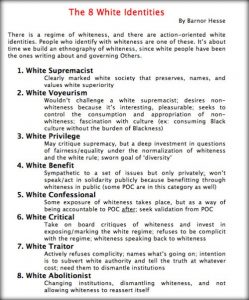
For instance, in New York City, an elementary school principal has encouraged parents to evaluate the eight identities of whiteness which range from being a full-blown white supremacist on one end to an all-out white abolitionist on the other. The term white abolitionist means denying whiteness altogether to dismantle systematic power and privilege. The eight identities of whiteness allow white people to identify their own racism and where they are in their attempts to eliminate it. Only by working to completely dismantle white hegemony can one expect to overcome their own bigotry.

This is like the Helms racial identity model found in an article entitled Owning Whiteness: The Reinvention of Self and Practice (Blitz, 2008) in the Journal of Emotional Abuse. Under this model, whiteness is broken down into six categories. Contact, disintegration, reintegration, pseudo-independence, immersion/emergence, and autonomy. These phases start with a white person being aware of racial differences but being satisfied with the status quo. The next phase realizes that there are social implications to whiteness that cause feelings of guilt. Reintegration involves adopting the attitude that whites have it better than people of color and, denying any responsibility for their own racism. Next, there are the recovery phases, which include white people becoming dependent on persons of color to help them define their racial identity. White people who recover from whiteness (if you will) emerge with new ideas on morality, and how to approach discussions about how other white people deal with their own racism (Blitz, 2008).

Unfortunately, many Americans remain blissfully unaware of how entrenched concepts like Critical Race Theory are in our education system. Having a degree in social work I have the added benefit of knowing where to find the latest news on white privilege education.

For example, the journal Understanding and Dismantling Privilege published an article entitled Considerations for Using Critical Theory and Critical Context Analysis: A Research Note. (Perez Huber, Gonzalez & Solorzano, 2018) The purpose of the article is to examine the best methods of determining whether there is racial bias in children’s books and the theoretical framework in which they should identify this bias. As a student at Liberty University, I took a class where we interpreted various stories through the lens of critical theory. This would entail any perspective that challenges what the left refers to as, the normative power structures. When examining children’s books for racial bias through a theoretical perspective like CRT, they are looking for anything that can fit that framework, even if the author did not intend it.

Along with CRT, the journal article above discusses two other theoretical perspectives from which they examine power and privilege. Critical multicultural analysis and critical context analysis. The first examines power relationships, looking for hidden ways in which dominant cultural ideologies are oppressing minorities. For example, if immigrants in a children’s book were portrayed as Mexican, Perez Huber, et al (2018), would claim the book is suggesting all Mexicans are immigrants. This is not true, of course, but for examining so-called hidden biases and implementing change, this would be the claim. Critical context analysis focuses on examining sociocultural elements of a story that may identify which characters may or may not have power and whose perspective the story is being told from (Perez Huber et al 2018).

The larger point of Perez Huber et al’s article is the merging of these three theories to frame a theoretical approach to implementing CRT in all aspects of education. Critical context and multicultural analysis’ are the research methodologies being used to question children’s literature and, identify what the left would view as racist or biased. CRT is a way of interpreting it. Because critical race theory is just a theory, there is no truth in any of it. Much of this is based purely on the pre-existing biases of those conducting the studies. They are looking for racism because they are critical race theory scholars who, in the absence of race theories, would have nothing better to do than twiddle their thumbs.

It is one thing to understand that they are teaching our children they are racists for being white. Taking the time to understand the perspectives and methodologies they operate from, to teach such things, is what we need if we are going to do something about it. They use theories like white privilege and critical race theory, along with words like systematic oppression to silence opposition and keep people afraid of speaking up.

The justifications used to prove this racism are laughable and only justified through the left’s ridiculous definitions of racism. For example, in the University of Oklahoma’s Master of Social Work Program I attended in 2013, we had a textbook that suggested a black woman was depressed because she sold herself out to the white man’s economic system and lost touch with her historic roots of oppression. As ridiculous as that sounds, the same concept is highlighted in the journal article I discussed. A critical analysis of the short story The Circuit, which is primarily about the triumphs of an immigrant and his journey to America, still highlights a system of white hegemony because the main character is pursuing the American dream (Perez Huber et al 2018). The implication being that the American culture is superior. According to Perez Huber et al (2018), the story pushes a racist narrative by focusing on the American dream and not the journey of the immigrant and, the struggles he endured as an immigrant.

It is hoped that by writing articles like this I am making readers aware of the deeper methodologies the left is using to push their theories. At the end of chapter one of the book, The Naked Communist, Cleon Skousen said if we could just study and come to understand the problem of Marxism, we may be able to save humanity. Unfortunately, he said this nearly seventy years ago and since that time, the left’s agenda has advanced almost unnoticed in terms of how deeply they have infiltrated our educational institutions. We must understand what it is they are doing if we stand any chance of defeating it on an ideological level. My intent is to give readers the opportunity to review these sources for themselves.

.


Methodologies of Critical Race Theory Part Two: Racist Mathematics


In my last article, I discussed some methods being used to examine education through a Critical Race Theory perspective. Critical multicultural analysis and critical contextual analysis are research models used to examine power relationships and the ways dominant cultures allegedly, oppress minorities. These concepts are applied to mathematics as well. Math education has been viewed as a method of teaching problem solving and finding a universal truth through numbers. There are no politics or racial problems in math, it just is what it is. Two plus two will always be four. Critical race theorists, however, have suggested that mathematics education is a vehicle from which power and identity can either be built upon or oppressed because math prowess is a symbol of societal prestige. In this article, I will examine how CRT applies in math by reviewing an article called The sociopolitical turn in mathematics education, by Rochelle Gutiérrez.

Most people assume the use of CRT in math education suggests the idea that math itself is racist because minorities are not as capable. Looking at the attitudes of the political left and how they have argued the need for a welfare state and other programs like affirmative action, this is a fair assumption. This is the same attitude that prompts someone like President Biden to suggest minorities are not smart enough to use a computer to find the closest place to receive a vaccine. Democrats seem to argue that minorities need the government to create a level playing field. Critical race theory in math goes a little deeper than arguing math is a social construct that promotes racism because of a so-called achievement gap. CRT examines how individual power and identity develop based on the power structures determining what minority students should learn about math (Gutierrez, 2013).

Like all aspects of our society, the political left has turned something as politically neutral as mathematics into a quest for social justice. Gutierrez (2013) argues math is a human invention. Therefore, it deals with issues of power and domination (Gutierrez, 2013). In my last article, I showed that much of this perspective represents a pre-existing bias, an already formed opinion that America is a racist society. By applying CRT to mathematics education, leftists scholars are seeking to transform mathematics in a way they suggest, balances societal privilege (Gutierrez, 2013). The key to achieving this, Gutierrez (2013) argues, is realizing politics in mathematics and other educational endeavors exist because they are man-made constructs. In other words, they are looking for racism where none exists. For example, in their book Critical Race Theory in Education, Adrienne Dixon and Celia Rosseau admit their ideas are assumed, and not proven. They reject the idea of equality under the law, and other aspects of American society as a matter of preferring their own theoretical perspectives. They are choosing to look for racism under an already existing assumption that it exists everywhere.

Citing the book Literacy: Reading the Word & the World by Paulo Freire and Donaldo Pereira Macedo, Gutierrez (2013) highlights that the purpose of teaching social justice in math is to allow learners to identify their place within the dominant power structure and, analyze data in a way that allows them to expose injustices in society. Mathematics teachers using the CRT perspective should be working, Gutierrez (2013) claims, to deconstruct racism and show how “whiteness” is the dominant cultural viewpoint. Challenging assumptions about racial hierarchies should be the driving factor in applying CRT to mathematics education.

The development of an individual’s identity through a CRT perspective is a bit complex, and in many ways, a social construct of its own that allows them to make claims of racial domination and oppression. This is the perspective that suggests math is a racist power structure. Gutierrez (2013) argues that identity is not only defined by the individual but from the lens of others around them. This may be true, to a degree. What she is saying is that math is racist and a tool of social oppression because they teach it from a perspective of white normality. Gutierrez (2013) notes that success in math carries a certain prestige and that people who are unsuccessful in math are less smart than those who excel in it. She also refers, as many leftists do, to American meritocracy as a myth. Meaning the idea that we are all equally capable if we apply ourselves is something that is largely, untrue. This coincides with the attitude of the left that minorities need affirmative action and other programs to make things equal. Gutierrez is proving that it is the left’s demented worldview that sees minorities as being incapable.

All math education should focus on carrying students as far as their abilities allow them to go. When ability and merit, however, are nothing but constructive myths, and the education system itself, something that is taught through the perspective of one dominant culture alone, this becomes an impossibility. Gutierrez (2013) argues that teaching math only to lessen the so-called achievement gap perpetuates whiteness and racism because it does not consider issues of identity. This is because the left views achievement also, from the perspective of white normality. In other words, comparing the abilities of minority students to standards held for white students perpetuates racism.

“Recognizing that the identities of individuals are constructed partly through the discourses that operate in mathematics education, we can begin to see how ability is socially constructed. The achievement gap is a perfect example. Although mainly concerned with the well-being of marginalized students (defined here as African American, Latina, American Indian/indigenous, working-class students, and English learners), mathematics education researchers who focus on the achievement gap support practices that often are against the best interests of those students. In fact, “gap gazing” offers little more than a static picture of inequities, supports deficit thinking and negative narratives about marginalized students, accepts a static notion of student identity, relies upon Whites as a comparison group, divides and categorizes students, ignores the largely overlapping distributions of student achievement, offers a “safe” proxy for talking about students of color without naming them, relies upon narrow definitions of learning and equity, and perpetuates the myth that the problem (and therefore solution) is technical in nature” (Gutiérrez, 2008a).

As I have said many times before. You must be a racist in the first place to think like this. Gutierrez is claiming that the perspectives of ability and merit from which they teach math, along with the idea that it is presented from a “position of whiteness,” is what creates the belief that minority students are inferior to whites. As if math itself is a construct that only white people understand. Gutierrez also claims that failing to teach math from a perspective that addresses issues of identity and power reduces students to nothing less than a standardized test score. This I agree with. Standardized tests are something that lowers standards for all students. I would also argue, however, that turning math into a sociopolitical issue, framing it from the perspective of people who have nothing better to do than find race in every issue for transformative change, has more to do with the idea that minorities are disadvantaged.

The lens from which the left views this issue is so black and white. It is as if there are no minority students who excel in mathematics. This is the problem with leftist thinking in general. They fail to recognize people on an individual level. They are obsessed with race because they are the ones who believe in the myth of white supremacy. I am terrible at math. I had to drop out of a metallurgy program because I could not grasp advanced trigonometry. Because of that, I naturally drifted towards something I was more suited for. Based on the left’s logic, are we to believe that there are no blacks or Hispanics that are good at math? Perhaps the larger problem here is that the truths of merit and individual efforts have been rejected by the left because they are determined to tear down the fabric of society so that they can build one to their own liking. One, no less, they refuse to see has failed time and time again. Perhaps the larger problem is that Critical Race Theory itself is the real social construct, based on Critical Theory, thought up by people looking to transform society from one of individualism to collectivism.


Dixon, A. D., & Rousseau, C. K. (2006). Critical race theory in education: All god’s children got a song. New York: Routledge. D

Freire, P., & Macedo, D. (1987). Literacy: Reading the word and the world. New York: Routledge

Gutiérrez, R. (2008a). A “gap gazing” fetish in mathematics education? Problematizing research on the achievement gap. Journal for Research in Mathematics Education, 39(4), pp. 357–364.

Gutiérrez, R. (2013). The sociopolitical turn in mathematics education. Journal for research in mathematics education, 44(1), pp. 37-68


Sunday, June 27, 2021

Critical Race Theory as a means of coercive thought reform


In my writing’s on Critical Race Theory, I attempt to draw attention to the fact that the theory itself is more than a method of teaching kids America is racist, it is a tool of cultural transformation. For instance, in Critical Theory as a psychoanalytical approach to the social pathology of racism, I discuss the idea of CRT being used to treat racism like a collective illness requiring treatment. Critical theory, being used as a method of societal critique, took a psychoanalytic approach to criticize culture for transformative change. This required, according to Verovsek (2019), self-reflection and self-awareness of one’s own attitudes before any corrective actions can be made. This is an important step in social critique because it induced feelings of guilt which in turn, prompts a willingness to go along with the program. Critical Race Theory, aside from simply teaching students that America is racist, or whites are privileged, is a tool of coercive persuasion and thought reform mimicking what the communists used in Mao’s cultural revolution.

My personal experience with Critical Race Theory involved writing an essay, a position paper, on my attitudes towards the concept of white privilege. After writing the paper, the instructor demanded we give a speech describing how we were unaware of our racist attitudes, and how our white privilege affected minorities. Anyone familiar with white privilege, or CRT, knows that virtually everything is racist because according to the left, we live in a system that promotes and supports white supremacy. There was no right course of action to take because being white has become the cardinal sin from which white people must redeem themselves. This is a carefully employed technique used in transforming one’s thoughts and behaviors to gain compliance and create new loyalties. For example, in an article entitled Maoist discourse and the mobilization of emotions in revolutionary China, Liu discusses the idea of guilt being used to force people to focus on their negative thoughts. Guilt in communist China, just as it is in Critical Race Theory, is a foregone conclusion (Liu, 2010). People were not just asked to confess their sins, or in the case of CRT, their privilege, but to provide personal examples and explain their understanding of how it affects other people (Liu, 2010). Language was shaped in a way that inferred guilt no matter which position you took because nearly everything became associated with the imperialist ideology. In CRT, nearly everything is blamed on white supremacy because the system we live in was built to enforce it.

According to Richard Ofshe, the public admission of guilt, along with the denouncing of what they deem as undesirable behaviors, prevents an individual from psychologically separating themselves from the experience. By forcing people to admit to crimes they are unsure they have committed, people become trapped in a cycle of mental uncertainty (Liu, 2010). This can be particularly true when the crimes in question are presented collectively. In CRT, the very act of being white is the same as being born racist. This assertion in and of itself lacks any logic, further confusing the individual in question. According to Meerloo (1961, p. 94), forced confessions and the public expression of shame provokes feelings of “childlike submissiveness” while also alleviating deep-rooted feelings of guilt that all people have. By submitting to, and aligning one's thoughts to the tenets of CRT, people can project their feelings of guilt onto others who refuse to do so.

It is one thing to put adults through this type of indoctrination but forcing it on elementary school children will not only result in unnecessary guilt but a population of people who cannot break away from the indoctrination and will submit to further brainwashing attempts. Ofshe describes coercive persuasion as an attempt to destroy an individual’s concept of self, create an unstable identity, and reinforce a need for peer approval. Critical Race theory attacks one’s allegiance to their own nation by claiming support for American ideals is intrinsically bigoted. By encouraging the personalization of guilt, the Chinese could induce feelings of self-doubt and instability among those targeted for behavioral change (Liu, 2010). Children in elementary school are not old enough to have a self-identity. By introducing them to the ideas of race consciousness and CRT, the left aims to destroy any possibility of a positive pro-American self-identity developing by associating induced feelings of guilt with America’s so-called, racist past. According to Ofshe, the fear of humiliation or standing out from the crowd is a distinguishing feature of coercive persuasion. This coincides with B.F. Skinner’s (1971, p. 72) assertion that behavioral control can be easily attained through systems of social approval/disapproval. As I mention in my book, Without a Shot Indeed: Inducing Compliance to Tyranny Through Conditioning and Persuasion, critical theory is being used to introduce kids to new ways of thinking about their culture, and systems of rewards and punishments are used to reinforce these beliefs. According to Ofshe, behavioral/attitude change is best achieved when rewards and punishments for the group are tied to the weakest individual. This forces an individual who is resistant to the ideology to conform for fear of being humiliated or blamed for the group’s failure to progress. Individuals who fail to conform and admit their privilege/racism are shamed and isolated from the group. My refusal to conform, for example, resulted in their attempts to remove me from the social work program while also attempting to associate everything I said with racism.

“The change phase allows the individual an opportunity to escape punishing destabilization procedures by demonstrating that he or she has learned the proffered ideology, can demonstrate an ability to interpret reality in its own terms and is willing to participate in competition with peers to demonstrate zeal, through displays of commitment. In addition, to study and/or formal instruction, the techniques used to facilitate learning and the skill basis that can lead to opinion change include scheduling events that have predictable influencing consequences, rewarding certain conduct, and manipulating emotions to create punishing experiences. Some of the practices designed to promote influence might include requiring the target to assume responsibility for the progress of less- advanced "students," to become the responsibility of those further along in the program, to assume the role of a teacher of the ideology, or to develop ever more refined and detailed confession statements that recast the person's former life in terms of the required ideological position. Group structure is often manipulated by making rewards or punishments for an entire peer group contingent on the performance of the weakest person, requiring the group to utilize a vocabulary appropriate to the ideology, making status and privilege changes commensurate with behavioral compliance, subjecting the target to strong criticism and humiliation from peers for lack of progress, and peer monitoring for expressions of reservations or dissent. If progress is unsatisfactory, the individual can again be subjected to the punishing destabilization procedures used during unfreezing to undermine identity, to humiliate, and to provoke feelings of shame and guilt.” (Ofshe, 2000)

By destroying identity and associating previous beliefs with racism, those using Critical Race Theory are setting themselves up as being morally superior (Liu, 2010). The continued forcing of denunciation and admissions of guilt are necessary to ensure the ideology remains enforceable (Liu, 2010), and those pushing it are looked to for redemption. The goal, just as it is in all communist societies, is the creation of a new man free from the trappings of bourgeois society and willing to surrender their previous identities to a higher cause (Liu, 2010). In Communist China, Mao presented his system of communism as morally superior, as class warfare was used to demonize those considered the upper classes while victimizing the poor. In Critical Race Theory, whites are considered the upper class, and a system of racial preferences is presented as the morally acceptable solution. Black Americans, along with other minorities, are presented as victims of white privilege, incapable of competing in a system that purportedly exists solely to keep minorities down. There is no escaping the accusations of racism as every aspect of our society has been weaponized to trap individuals into the CRT narrative. For instance, in my article, Methodologies of Critical Race Theory part two: Racist mathematics, I discussed the idea put forth by the Journal for research in mathematics education that honest efforts to solve educational issues such as the achievement gap, for example, are in and of themselves, systems of whiteness because achievement is a white construct. In Critical Theory as a psychoanalytical approach to the social pathology of racism, I showed the conflicting ideologies of those pushing CRT by citing the book Critical Race Theory: An Introduction. On one hand, they argue race is a social construct, while also insisting that a color-blind approach to race issues only solves the most evident forms of discrimination. They also claim that white people fail to see the things all human beings have in common because we prefer to judge people based on the color of their skin. These two views cannot co-exist. Suggesting that achievement, for example, is a white construct, while arguing for a system of racial preferences because minorities cannot compete fairly in a free-market system, is judging people based on the left’s own racial biases.

Forced confessions and inducing feelings of guilt were methods employed by the communists in Mao’s cultural revolution. The goal was to create a new man, and a new way of thinking where individuals realigned their loyalties to a system Mao deemed as morally superior. Teaching children they are automatically racist by the virtue of being born white is done to destroy their identity, discredit the culture of their parents and ensure adherence to an ideology meant to culturally transform the nation. Systems of rewards and punishments are being used to force conformity in elementary schools based on what they have known about behavior and attitude change for decades. Children in elementary school know nothing of racism. Critical Race Theory is a method of thought reform using coercive persuasion methods meant to produce feelings of guilt and a hatred for one’s national identity. It is a tool of cultural transformation being used to change the consciousness of the younger generation to see everything from the twisted perspectives of the left.

Delgado, R., Stefanic, J., & Harris, A. Critical race theory: An introduction (2017) New York University Press Critical Race Theory: An Introduction

Gutiérrez, R. (2008a). A “gap gazing” fetish in mathematics education? Problematizing research on the achievement gap. Journal for Research in Mathematics Education, 39(4), pp. 357–364.

Liu, Y. (2010) Maoist discourse and the mobilization of emotions in revolutionary China. Modern China 36(3) pp. 329-362. Sage Publications.

Meerloo, J, A, M. Rape of the Mind. (1961) Martino Fine Books. Rape of The Mind: Joost Meerloo: Free Download, Borrow, and Streaming: Internet Archive

Ofshe, R. J. Coercive persuasion and attitude change. From The encyclopedia of sociology, volume 1. (2000) Macmillan, New York.

Skinner, B. F. Beyond Freedom and Dignity. (1971) Pelican Books, Middlesex England. BF-Skinner-Beyond-Freedom-&-Dignity-1971.pdf (selfdefinition.org) 


Be sure to check out my latest book

Without a Shot Indeed: Inducing Compliance to Tyranny Through Conditioning and Persuasion 

Propaganda and the Dependent Relationship Between Government and the Public

  In just a couple of days Americans will be rushing to the polls under a very misguided belief they are punishing the party in power or sta...